The Best Dog Food for Dobermans, Compared Label by Label
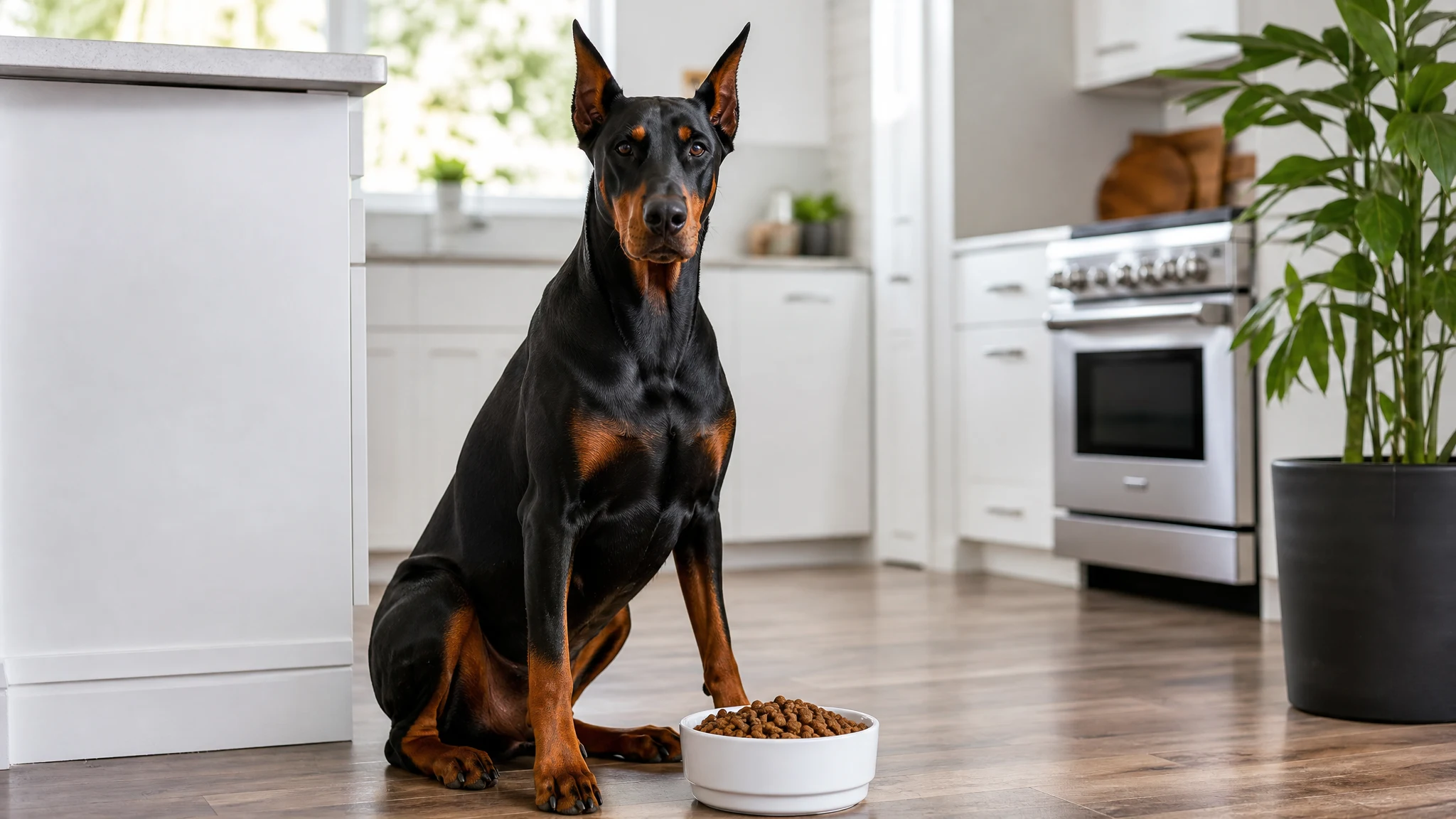
General nutrition information compiled from product labels and published sources, not veterinary advice. Your veterinarian is the right person to choose a diet for your dog, especially one with a health condition.
There is no single best dog food for Dobermans. There are foods whose labels fit a large, deep-chested, athletic dog at a given life stage, and foods whose labels do not. This guide shows you how to read those labels and where ten real products land when you do.
It is a guide to reading labels, not a verdict handed down from a test kitchen. Where a number is missing, we say so and point you to the brand.
How we compared these foods
We compared label data only. For each product we looked at the AAFCO nutritional adequacy statement, the life stage, the first five ingredients, the protein, fat and fiber figures, calories per cup and the feeding guide published by the brand.
We did not run feeding trials. We did not do taste tests. We did not feed any of these foods to a dog. Nothing here says how a food performs in a bowl or in a particular dog, and nothing here replaces your veterinarian's view of your dog.
Some points about the data:
- Prices, star ratings and customer reviews were left out on purpose. They change often and say little about what is in the bag.
- Kibble size is not stated on any of the brand pages we read, so we cannot compare it. If your dog gulps food or struggles with large pieces, check with the brand.
- We found no food made specifically for Dobermans. Royal Canin, Hill's and Victor all sell large breed recipes, but none of the pages we read showed a Doberman line. Be wary of any bag that claims one without showing an AAFCO statement to back it up.
- Hill's publishes average nutrient values, not guaranteed minimums. We keep those separate from the minimums used by the other brands, because the two are not the same kind of number.
What the Doberman Pinscher needs from a label
The Doberman Pinscher Club of America (DPCA) Official Standard sets the breed's height. Hill's Pet Nutrition lists adult weight at 60 to 100 pounds, males usually heavier than females, and height at 24 to 28 inches. PetMD gives the same 60 to 100 pound range. Hill's classes the breed as large.
That size shapes what to look for in a Doberman food:
- A life stage that matches the dog. A growing puppy and a ten-year-old do not need the same bag.
- A large-dog growth clause for puppies. This is the single most important line on a puppy food label. More on it below.
- Calories you can measure. Large dogs are fed by the cup, and a few extra cups a week add up. Calories per cup tell you how dense the food is.
- A feeding plan that suits a deep chest. PetMD advises feeding adult Dobermans two meals a day instead of one large meal, to reduce the risk of gastric dilatation volvulus (GDV, or bloat). Ask your veterinarian what is right for your dog.
The DPCA health page notes that large breeds are at increased risk of hip and elbow dysplasia, and that weight control matters. Keeping a Doberman lean starts with measuring portions. It is not a claim that any food prevents a joint problem.
Key label features to compare
The AAFCO statement
Look for a sentence saying the food is complete and balanced and naming a life stage. There are two ways a brand can back that up. Some foods are substantiated by animal feeding tests using AAFCO procedures. Others are formulated to meet the AAFCO Dog Food Nutrient Profiles. Hill's Science Diet pages use the feeding test wording. Royal Canin, Victor and Freshpet use the formulated-to-meet wording. Both are legitimate routes, and neither tells you how a particular dog will do.
The large-dog growth clause
Whole Dog Journal explains that a food labeled for growth or for all life stages must say either "including growth of large-size dogs (70 lb or more as an adult)" or "except for growth of large-size dogs (70 lb or more as an adult)." A Doberman puppy will usually be an adult of 60 to 100 pounds, so look for the "including" version. If the bag says "except," it is not a puppy food for this breed.
Protein, fat and fiber
These are the guaranteed analysis figures. Protein and fat are minimums, and fiber is a maximum. They are as-fed numbers, so a wet food will look low next to a dry one because of the water in it. Do not compare a pate to a kibble on these numbers alone.
Calories per cup
This is the number that matters most for portions. The foods below range from about 337 to 406 calories per cup for the dry and fresh foods. A food at 406 calories per cup needs a smaller scoop than one at 350 for the same energy.
First five ingredients
Ingredients are listed by weight before cooking, so fresh meat can look heavy on the list because it contains water. A named meat meal, such as chicken meal, is meat with the water removed. Neither is better or worse by itself. Read the list for specifics: a named protein, a named fat, and no vague terms you cannot identify.
Label data at a glance
Figures come from each brand's published product information. Hill's figures are dry matter averages, not minimums, and are marked as such.
| Food | Form | Life stage on label | Protein / fat / fiber | Calories |
|---|---|---|---|---|
| Hill's Science Diet Puppy Large Breed Chicken & Brown Rice | Dry | Growth, large breed puppies, up to 18 months | Averages 26.7 / 15.4 / 2.8 percent | 387 per cup |
| Victor Classic Hi-Pro Plus Large Breed Puppy | Dry | All life stages (check bag for the clause) | 30 min / 14 min / 6 max percent | 365 per cup |
| Hill's Science Diet Adult Large Breed Chicken & Barley | Dry | Adult maintenance, large breed | Averages 23.8 / 15 / 1.7 percent | 365 per cup |
| Royal Canin Size Health Nutrition Large Breed Adult | Dry | Adult maintenance, 15 months to 5 years | 24 min / 15 min / 3.3 max percent | 360 per cup |
| Victor Classic Hi-Pro Plus | Dry | All life stages except large-dog growth | 30 min / 20 min / 3.8 max percent | 406 per cup |
| Hill's Science Diet Adult 6+ Large Breed | Dry | Adult maintenance, 6 years and up | Averages 18.7 / 13.5 / 2.4 percent | 352 per cup |
| Victor Senior Healthy Weight | Dry | Adult maintenance | 27 min / 11.5 min / 4.5 max percent | 360 per cup |
| Victor Chicken and Rice Formula Pate | Wet | Growth and maintenance, except large-dog growth | 9 min / 6 min / 1 max percent | 448 per 13.2 oz can |
| Freshpet Large Dog Multi-Protein Recipe | Fresh, refrigerated | Adult maintenance | 20 min / 14 min / 1 max percent | 348 per cup |
| Freshpet Vital Large Breed | Fresh, refrigerated | All life stages per page (check package) | 20 min / 14 min / 1 max percent | 337 per cup |
| Just Food For Dogs Beef & Russet Potato | Fresh, frozen | Adult maintenance, not for puppies | 8.5 min / 7 min / 1.5 max percent | 44 per oz, 792 per 18 oz pack |
Picks by situation
You may expect a list of picks by price. We did not collect prices, so we cannot rank by cost honestly. Picks are grouped by situation instead, and the label data is what you can check against any bag you pick up. Each entry says what the label shows and who it may suit. None of these is a recommendation for your individual dog.
Puppy
Hill's Science Diet Puppy Large Breed Chicken & Brown Rice. The label says feeding tests using AAFCO procedures substantiate it for growing puppies. Hill's states it is for large breed puppies (over 55 pounds as adults) up to 18 months. The first five ingredients are chicken, brown rice, whole grain oats, chicken meal and cracked pearled barley. It carries 387 calories per cup. Hill's gives averages of 26.7 percent protein, 15.4 percent fat and 2.8 percent fiber on a dry matter basis. This fits the growth stage, but note the age: Hill's says Dobermans often keep filling out until age 2 or 3, so ask your veterinarian when to move on.
Victor Classic Hi-Pro Plus Large Breed Puppy. The label says it meets the AAFCO profiles for all life stages. Protein is at least 30 percent, fat at least 14 percent and fiber at most 6 percent, at 365 calories per cup. The first five ingredients are chicken, chicken meal, brown rice, whole grain millet and whole grain sorghum. The page text we read did not show whether the "including growth of large-size dogs" clause is printed, so check the bag for it before you buy.
On growth, Whole Dog Journal says large and giant breed puppy diets have a maximum of 1.8 percent calcium on a dry matter basis and an ideal calcium to phosphorus ratio of 1.1:1 to 1.4:1, with no supplemental calcium added to a complete and balanced diet. It also says large puppies need to grow slowly to prevent developmental orthopedic disease. Ask the brand for the calcium figure if it is not on the bag.
Two foods in this comparison are not puppy foods for this breed, even though they mention growth: Victor Classic Hi-Pro Plus and Victor Chicken and Rice Formula Pate both carry statements that exclude growth of large dogs (70 pounds or more as adults).
Adult
Hill's Science Diet Adult Large Breed Chicken & Barley. It is substantiated by AAFCO feeding tests for adult maintenance and is meant for adults aged 1 to 5 years, 55 to 110 pounds. The first five ingredients are chicken, cracked pearled barley, brown rice, brewers rice and whole grain wheat. It has 365 calories per cup. Hill's averages are 23.8 percent protein, 15 percent fat and 1.7 percent fiber on a dry matter basis. Its feeding guide runs from 3 1/4 cups a day for a 50 pound dog to 5 1/3 cups a day for a 100 pound dog. Treat that as a starting point and adjust to keep your dog at a healthy weight.
Royal Canin Size Health Nutrition Large Breed Adult. It is for large dogs aged 15 months to 5 years weighing 56 to 100 pounds, formulated to meet the AAFCO profiles for maintenance. The first five ingredients are chicken by-product meal, brewers rice, wheat, brown rice and chicken fat. Calories are 360 per cup, with protein at least 24 percent and fat at least 15 percent. The two retail listings we saw disagree on maximum fiber (3.2 and 3.3 percent), and we could not reach the brand's own page, so confirm fiber and the full adequacy statement on the bag.
Victor Classic Hi-Pro Plus. This is a high-energy formula at 406 calories per cup with at least 30 percent protein and 20 percent fat. The first ingredients are beef meal, grain sorghum, chicken fat, whole grain millet and blood meal. It excludes growth of large dogs, so it is an adult option only. Because it is calorie dense, portions are smaller than with the other dry foods here. The brand suggests adding half a cup for every 20 pounds over 100 pounds. A dog that is already lean and very active is the case this formula is built for. A less active dog may find it too rich.
Senior
Hill's Science Diet Adult 6+ Large Breed Chicken Meal, Barley & Rice. It is substantiated for adult maintenance by AAFCO feeding tests and is meant for dogs aged 6 and up, 55 to 110 pounds. It has 352 calories per cup. Hill's averages are 18.7 percent protein, 13.5 percent fat and 2.4 percent fiber. The first five ingredients are chicken meal, cracked pearled barley, brewers rice, whole grain wheat and whole grain corn. It is not meant for large breed puppies.
Life expectancy matters when you decide what counts as senior. Hill's puts it at 10 to 12 years. The World Small Animal Veterinary Association (WSAVA) cites Finnish statistics of about 8 years, tied mainly to dilated cardiomyopathy (DCM). So the age at which your dog is senior is a conversation for your veterinarian.
Weight control
Victor Senior Healthy Weight. The label says it meets the AAFCO profiles for adult maintenance. It carries at least 27 percent protein, at least 11.5 percent fat, at most 4.5 percent fiber, and 360 calories per cup. The first five ingredients are beef meal, whole grain brown rice, whole grain millet, grain sorghum and chicken fat. The page includes a weight-reduction table for adult dogs. It also says it is generally recommended to start large breeds on a glucosamine and chondroitin fortified food early in life. That is the brand's own statement, and we are not endorsing it. Ask your veterinarian before changing anything for a joint reason.
For any weight plan, the food matters less than the measuring cup and the scale. Weigh your dog at home or at the clinic, and ask your veterinarian for a target.
Sensitive stomach
We cannot name a pick here. None of the product pages we read is labeled for a sensitive stomach, and the information we have does not tell us what a given dog can tolerate. If your Doberman has loose stools or vomiting, see your veterinarian before changing foods. Prescription diets exist for medical problems, and only a veterinarian can prescribe them.
If your veterinarian agrees to a switch, a gradual changeover is the norm. Just Food For Dogs, for one, recommends introducing its food slowly over 3 to 5 days.
Wet
Victor Chicken and Rice Formula Pate. The label says it meets AAFCO profiles for growth and maintenance, but it excludes growth of large dogs, so for a Doberman it is an adult food. Protein is at least 9 percent, fat at least 6 percent and fiber at most 1 percent, with 448 calories per 13.2 ounce can. The first five ingredients are chicken, chicken broth, chicken liver, brown rice and dried egg product. The brand suggests 3/4 to 1 can per 15 pounds of body weight for adults, which by simple arithmetic is several cans a day for a full-size Doberman. Many owners use a wet food as a topper over dry. Whether that is right for your dog is a question for your veterinarian.
Fresh
Freshpet Large Dog Multi-Protein Recipe. Refrigerated and fully cooked, formulated to meet AAFCO profiles for adult maintenance. The first five ingredients are chicken, egg, beef, salmon and beef liver. Protein is at least 20 percent, fat at least 14 percent and fiber at most 1 percent. It has 348 calories per cup. The brand's guide lists 2 1/2 to 3 cups a day for dogs of 51 to 65 pounds, and says it can be fed as one meal or split into two. The range we saw stops at 65 pounds, so ask the brand about larger dogs. Given the bloat advice above, splitting it into two meals is worth discussing with your veterinarian.
Freshpet Vital Large Breed. Same format, with chicken, beef, egg, salmon and beef liver as the first five ingredients, and 337 calories per cup. The page says all life stages, but we could not confirm the large-dog growth clause, so check the package before feeding it to a puppy. Freshpet says to use it within 7 days of opening.
Just Food For Dogs Beef & Russet Potato. A frozen fresh recipe for adult maintenance, and the page says it is not intended for growing puppies. The first five ingredients are beef, beef liver, russet potatoes, sweet potatoes and carrots. Protein is at least 8.5 percent, fat at least 7 percent and fiber at most 1.5 percent. It has 44 calories per ounce, or 792 per 18 ounce pack. The page offers a feeding calculator rather than fixed portions. The page does not call this grain-free, but the ingredient list has no grains, so it reads that way. Read the next section before deciding.
Grain-free, potatoes and the FDA
Dobermans are one of the breeds where DCM comes up often. Hill's notes that some Dobermans have a genetic predisposition and advises early screening and yearly monitoring. WSAVA estimates that 20 to 50 percent of the breed is affected.
The U.S. Food and Drug Administration's Center for Veterinary Medicine began investigating in July 2018 after reports of DCM in dogs eating diets with peas, lentils, other pulses or potatoes high in the ingredient list, many labeled grain-free. FDA's last update was on December 23, 2022. FDA said it does not plan further public updates until there is meaningful new scientific information, and that no cause has been established.
That is not a finding that any food on this page causes or prevents anything. It is a reason to ask your veterinarian about diet and heart screening, and to read ingredient lists rather than front-of-bag claims. We make no claim that any food here helps or harms the heart.
Red flags on a Doberman food label
- No AAFCO statement, or only part of one. If you cannot find a life stage and a complete and balanced claim, move on.
- "Except growth of large-size dogs" on a puppy food. That wording rules the food out for a Doberman puppy.
- An all-life-stages claim with no large-dog clause. Ask the brand which version applies.
- A bag that claims to be "for Dobermans." We found no such formula. Check the AAFCO statement instead of the picture on the front.
- Disease claims. A pet food that says it treats or cures allergies, heart disease, hip dysplasia or bloat is making a medical claim. Diet decisions for a sick dog belong to a veterinarian.
- Added calcium on a puppy food. Whole Dog Journal says a complete large puppy diet needs no supplemental calcium.
- Vague ingredients. Terms like "meat meal" without a named animal tell you little.
- Guarantee language. No food can promise results for every dog.
Where to buy and how to check before you do
Brands publish their own product pages, which are the best place to confirm the current formula, the AAFCO statement and the feeding guide. Retailers can show older or incomplete label text, and our own data shows it: the two retail listings we saw for one large breed food disagreed on fiber.
Before you commit to a bag, check these things in order:
- Read the AAFCO statement on the physical bag, including the large-dog growth clause for puppies.
- Compare calories per cup with what you are feeding now, so portions do not jump.
- Ask the brand where its product is sold, including fresh and frozen lines that only stock in certain stores. We do not link to stores.
- Start with a small bag if you can, and change foods gradually.
- Tell your veterinarian what you plan to feed and show them the label.
Using feeding guides sensibly
A bag's feeding chart is a starting point, not a prescription. Activity, age, environment and body condition change how much a Doberman needs, as Victor says on its own wet food page. Weigh your portions, check your dog's body condition every few weeks, and adjust.
With adult Dobermans, PetMD advises two meals a day instead of one big meal. That is worth raising at your next visit, especially if you plan to try a fresh food that offers either option.
The short version
- For a puppy, look for a large breed growth food with the "including growth of large-size dogs" clause.
- For an adult, pick a life stage that matches, then compare calories per cup, not just protein.
- For a senior or an overweight dog, plan portions with your veterinarian.
- For wet or fresh foods, check the AAFCO statement and the portion guide for dogs over 65 pounds.
- For anything medical, including a sensitive stomach or heart concerns, start with your veterinarian.
The best dog food for Dobermans is the one that fits your dog's life stage and body condition, has a clear AAFCO statement, and that your veterinarian is comfortable with. These labels give you a way to narrow the choices before that conversation.
Sources
- Doberman Pinscher Club of America, Official Standard
- Doberman Pinscher Club of America, Health
- Hill's Pet Nutrition, Doberman Pinscher Dog Breed Guide
- PetMD, Doberman Pinscher Dog Breed Health and Care
- WSAVA, Meet the Dobermann
- FDA Center for Veterinary Medicine, Investigation into Potential Link between Certain Diets and Canine Dilated Cardiomyopathy
- Whole Dog Journal, In the Fine Print: Nutritional Adequacy Statements
- Whole Dog Journal, Best Large Breed Puppy Food
- Hill's Science Diet Puppy Large Breed Chicken & Brown Rice
- Hill's Science Diet Adult Large Breed Chicken & Barley
- Hill's Science Diet Adult 6+ Large Breed
- Victor Classic Hi-Pro Plus Large Breed Puppy
- Victor Classic Hi-Pro Plus
- Victor Senior Healthy Weight
- Victor Chicken and Rice Formula Pate
- Freshpet Large Dog Multi-Protein Recipe
- Freshpet Vital Large Breed
- Just Food For Dogs Beef & Russet Potato