How Much to Feed a Doberman: Feeding Chart by Age and Weight
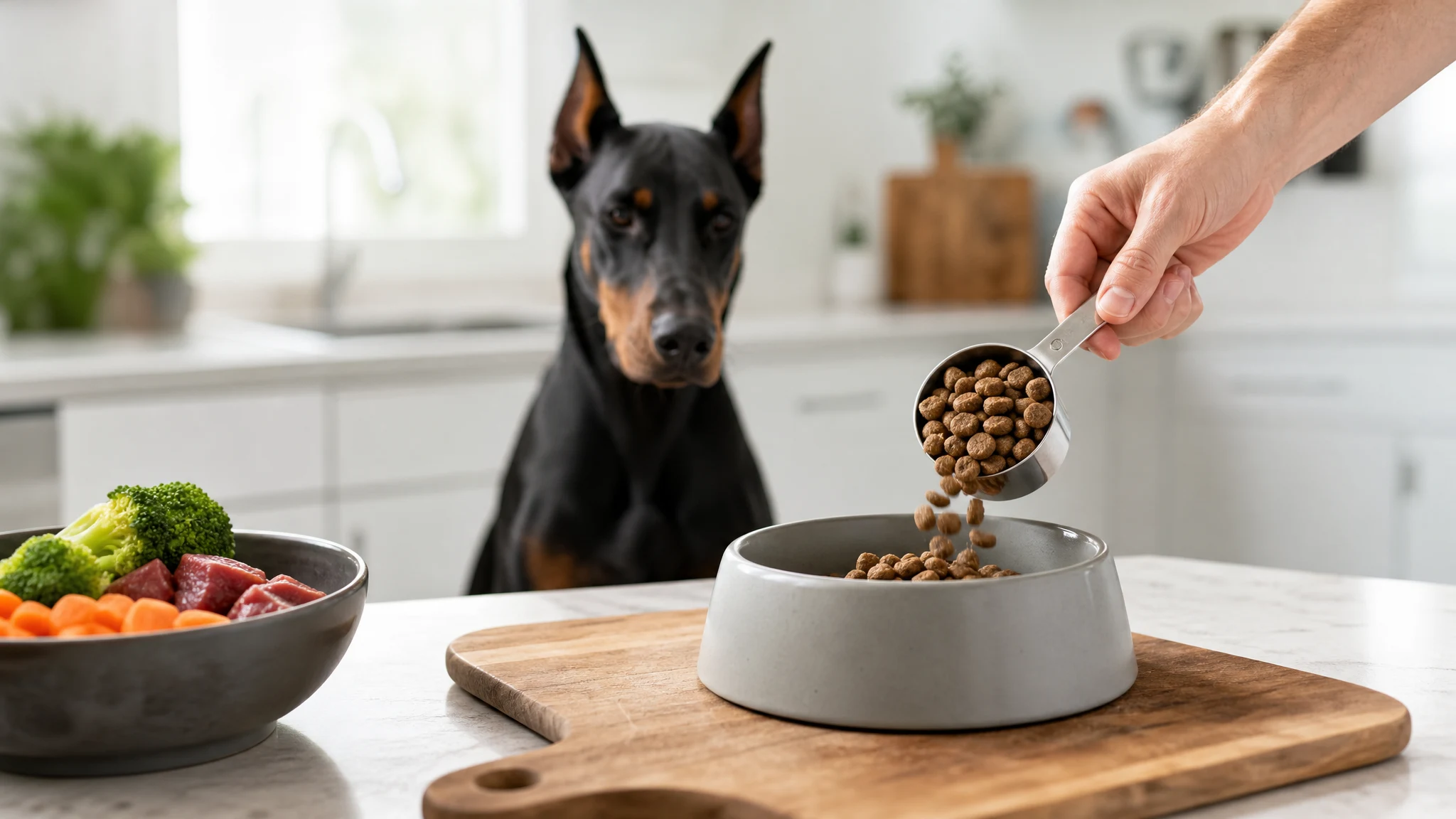
General nutrition information compiled from product labels and published sources, not veterinary advice. Your veterinarian is the right person to choose a diet for your dog, especially one with a health condition.
Working out how much to feed a Doberman sounds simple until you open three bags and find three different cup counts. Food labels list amounts for a dog of a given weight, but a Doberman's right portion also depends on age, build, activity and the food's calories.
This guide shows how to turn a label guide into a daily starting amount, check it against your dog's body shape, and adjust over time. The chart below uses label data only. A veterinarian sets the amount for an individual dog, and the numbers here are starting points, not prescriptions.
What a Doberman weighs, and why it matters for portions
Hill's Pet Nutrition's Doberman Pinscher breed guide lists adults at 60 to 100 pounds, with males usually heavier than females, and 24 to 28 inches tall. PetMD agrees on the 60 to 100 pound range. Hill's classes the breed as large. The Doberman Pinscher Club of America's official standard gives height only, so weight is not part of the breed standard.
That 40 pound spread is why one portion never fits every Doberman. A 65 pound female and a 95 pound male can both be at a healthy weight and need very different amounts.
Hill's also notes that Dobermans often keep filling out until age 2 or 3. A dog that looks lean at 18 months may simply not be finished growing.
How we built the chart
We compared label data: the feeding guides, calories per cup and nutrient statements that brands publish on their own pages. We did not run feeding trials or taste tests, and we did not feed any of these foods to dogs. The chart shows what each label says, so you can see how much the guides differ.
No Doberman-specific formula turned up in the Royal Canin, Hill's or Victor pages we looked at. Every food below is a large breed or all-around formula. If a bag claims to be made for Dobermans, check the label and ask your veterinarian before relying on it.
What you need
- The bag, can or package label of the food you are actually feeding
- A standard measuring cup, or better, a kitchen scale (cups of kibble vary by how they are packed)
- Your dog's current weight from a recent vet visit or a home scale
- A notebook or phone note for weights, portions and body condition
- Your veterinarian's contact details for questions
Doberman feeding chart: label starting points
The table lists only amounts that the brands publish. Where a brand's page gives two weights, we show those two and do not guess the numbers in between. The calorie totals are simple multiplication of the label's cups by its calories per cup, rounded.
| Life stage | Food (label used) | Dog weight | Label amount per day | Calories per cup | Approx. calories per day |
|---|---|---|---|---|---|
| Adult, 1 to 5 years | Hill's Science Diet Adult Large Breed Chicken & Barley (dry) | 50 lb | 3 1/4 cups | 365 | about 1,190 |
| Adult, 1 to 5 years | Hill's Science Diet Adult Large Breed Chicken & Barley (dry) | 100 lb | 5 1/3 cups | 365 | about 1,950 |
| Mature adult, 6+ years | Hill's Science Diet Adult 6+ Large Breed Chicken Meal, Barley & Rice (dry) | 50 lb | 3 cups | 352 | about 1,060 |
| Mature adult, 6+ years | Hill's Science Diet Adult 6+ Large Breed Chicken Meal, Barley & Rice (dry) | 160 lb | 7 cups | 352 | about 2,460 |
| Adult | Freshpet Large Dog Multi-Protein Recipe (fresh) | 51 to 65 lb | 2 1/2 to 3 cups | 348 | about 870 to 1,040 |
| Adult | Victor Classic Hi-Pro Plus (dry) | Over 100 lb | Add 1/2 cup for every 20 lb over 100 lb | 406 | Base amount: see the brand's page |
| Adult | Victor Chicken and Rice Formula Pate (wet) | Per 15 lb of body weight | 3/4 to 1 can | 448 per 13.2 oz can | about 336 to 448 per 15 lb |
| Growing puppy, up to 18 months | Hill's Science Diet Puppy Large Breed Chicken & Brown Rice (dry) | By weight and age | See the growth table on the brand's page | 387 | Depends on the table row |
A few notes on reading the table:
- The Hill's adult label uses 50 and 100 pounds. A 75 pound Doberman falls between those two rows, so use the brand's full chart.
- The Freshpet row stops at 65 pounds, so it does not cover most adult Dobermans on its own. Use the weight row for your dog from the brand's page. Freshpet says its large breed recipes can be fed as one meal daily or split into two.
- The Victor pate guide scales with weight. By the label's own math, a 60 pound dog works out to 3 to 4 cans a day. Check that against the calories you need before treating it as a full diet.
- Royal Canin Size Health Nutrition Large Breed Adult is for dogs of 56 to 100 pounds, 15 months to 5 years, and lists 360 kcal per cup. We could not confirm its feeding chart from the brand's own page, so check the amounts on the bag or at royalcanin.com.
Brand pages: Hill's adult large breed, Hill's adult 6+ large breed, Hill's puppy large breed, Victor Hi-Pro Plus, Victor Chicken and Rice Pate, Freshpet Large Dog Multi-Protein.
Step-by-step: how to find your Doberman's daily amount
Step 1. Pick a food that fits the life stage
This step matters most for puppies. The Whole Dog Journal explains that a food for growth or all life stages must say either "including growth of large-size dogs (70 lb or more as an adult)" or "except for growth of large-size dogs (70 lb or more as an adult)." A Doberman puppy's adult weight is 60 to 100 pounds, so look for the "including" wording.
Some foods carry the "except" version. According to Victor's pages, Hi-Pro Plus and the Chicken and Rice Pate exclude growth of large dogs, so they are not suited to Doberman puppies. Hill's says its large breed adult and 6+ foods are not for large breed puppies.
For the Victor Hi-Pro Plus Large Breed Puppy and Freshpet Vital Large Breed, the pages say all life stages. We could not confirm that the large-size growth clause is printed, so read it on the package.
Step 2. Find the weight row on the label
Weigh your dog, then find the closest row in the brand's feeding guide. If your dog is between rows, use the brand's full chart or ask your vet. Do not round up to be generous. Guides are written for typical dogs, and many label guides are a starting range.
Step 3. Check the calories
Calories per cup vary between foods. In the table, they run from 348 to 406 per cup among the dry and fresh foods. Swapping foods cup for cup can shift your dog's daily calories without you noticing. When you change foods, redo this step with the new label.
Step 4. Split it into meals
PetMD advises feeding adult Dobermans two meals per day instead of one larger meal to reduce the risk of gastric dilatation volvulus, also called bloat. That is a general guide, not a promise of protection. Ask your vet about meal timing, and about what to watch for. For puppies, we found no meal-count figure we could cite, so follow the label and your vet's advice.
Step 5. Measure every meal
Use the same cup or scale each time. A scoop can hold noticeably more than a level cup, and the difference adds up over weeks. Count treats and training rewards toward the day's food. Your vet can tell you how much room to leave for them.
Step 6. Score body condition and adjust
The scale tells you weight. Your hands and eyes tell you condition. Body condition scoring is a quick, hands-on check that vets use to judge whether a dog is lean, ideal or carrying extra weight. Many clinics use a 5-point or 9-point scale. Ask your vet to show you the scale they use and where your Doberman sits on it.
Do the check at home every few weeks:
- Ribs: run your hands along the sides. You should feel the ribs under a thin layer of padding without pressing hard. If you must dig to find them, ask your vet if the portion is too large. If they stick out sharply, ask if it is too small.
- Waist: look down from above. A healthy outline usually narrows behind the ribs.
- Tuck: look from the side. The belly should rise toward the hind legs, not hang level or sag.
Dobermans are naturally lean and deep-chested, so a visible rib or two on a muscular, active dog does not always mean underfeeding. Your vet can judge that. Hill's feeding notes also say to adjust to maintain optimal weight, which is the same idea: the label is the opening bid and the dog's body is the answer.
Step 7. Adjust for activity and life stage
A dog that runs, trains and plays daily will often need more food than a calm companion of the same weight. A dog recovering from illness, or slowing with age, may need less. Make small changes and recheck condition for a few weeks before changing again. A cup or scale reading that works in a busy month may be too much in a quiet one.
Large breeds are prone to joint problems. The Doberman Pinscher Club of America notes that large breeds are at increased risk of hip and elbow dysplasia and that weight control matters. That is a reason to avoid overfeeding, not a claim that any food prevents or treats the condition.
Step 8. Write it down and review with your vet
Record weight, cups or grams, treats and condition notes monthly for puppies and every few months for adults. Bring the notes to checkups. Your veterinarian sets the amount for an individual dog, and may change it based on age, health and any condition they are managing.
Puppy notes
Large and giant breed puppies are meant to grow steadily rather than fast. The Whole Dog Journal reports that large and giant breed puppy diets have a maximum of 1.8 percent calcium on a dry matter basis, an ideal calcium to phosphorus ratio of 1.1:1 to 1.4:1, and no supplemental calcium on a complete and balanced diet. It explains that slow growth is meant to lower the risk of developmental orthopedic disease. That is a secondary source, so ask your vet whether the puppy food you chose meets those guidelines.
Hill's lists its large breed puppy food for growth up to 18 months. When your dog reaches the age your vet considers adult, switch to an adult food by blending the old and new over several days. We did not find a source that states exactly when a Doberman counts as an adult, so let your vet decide.
Common mistakes to avoid
- Feeding by the bag's top number. The guide for a heavier dog may be far more than yours needs.
- Using an adult-only food for a puppy. Check for the "including growth of large-size dogs" clause.
- Forgetting treats. They count.
- Switching foods and keeping the cup count. Calories per cup differ.
- Treating label averages as minimums. Hill's pages publish average nutrient values, not guaranteed minimums, so compare them only with other average values.
- Judging by weight alone. Two Dobermans at 80 pounds can look quite different.
- Making big jumps in portion. Change in small steps and recheck.
A note on diet and heart health
Hill's says some Dobermans have a genetic predisposition for dilated cardiomyopathy (DCM) and advises early screening and yearly monitoring. The World Small Animal Veterinary Association estimates 20 to 50 percent of the breed is affected, and cites Finnish statistics of about 8 years of life expectancy, while Hill's and PetMD give 10 to 12 years. The sources disagree, so treat the lifespan as a range.
The U.S. FDA began investigating a possible link between certain diets and canine DCM in July 2018. Its diets of concern had peas, lentils, other pulses or potatoes high in the ingredient list, and many were labeled grain-free. The FDA's last public update was December 23, 2022, and no cause has been established. Ask your vet about your dog's heart screening and what food suits your Doberman.
What to expect
With steady measuring, many owners find their dog's weight and body shape become easier to keep stable over a few weeks. A dog fed an appropriate amount may hold a lean, athletic outline, with steady energy and regular stools. Results vary by dog, and a food or portion change cannot promise any health outcome. If your Doberman gains or loses weight without a clear reason, or changes appetite suddenly, call your veterinarian.
Quick recap
- Choose a food labeled for your dog's life stage, with the large-size growth clause for puppies.
- Read the label's amount for your dog's weight and note the calories per cup.
- Split the day's food into at least two meals for adults.
- Measure each meal and count treats.
- Check ribs, waist and tuck every few weeks.
- Adjust in small steps for activity and age.
- Review with your veterinarian, who sets the amount for your dog.
Sources
- Doberman Pinscher Club of America, Official Standard
- Doberman Pinscher Club of America, Health
- Hill's Pet Nutrition, Doberman Pinscher Dog Breed Guide
- PetMD, Doberman Pinscher Dog Breed Health and Care
- WSAVA, Meet the Dobermann
- FDA Center for Veterinary Medicine, Investigation into Potential Link between Certain Diets and Canine Dilated Cardiomyopathy
- Whole Dog Journal, In the Fine Print: Nutritional Adequacy Statements
- Whole Dog Journal, Best Large Breed Puppy Food
- Victor, Hi-Pro Plus Large Breed Puppy
- Freshpet, Vital Large Breed