Best Dog Food for a Doberman With a Sensitive Stomach
General nutrition information compiled from product labels and published sources, not veterinary advice. Your veterinarian is the right person to choose a diet for your dog, especially one with a health condition.
A loose stool or a skipped meal can worry any Doberman owner. This guide walks you through how to choose the best dog food for sensitive stomach concerns in a Doberman, using label data instead of marketing claims.
One point first. No brand page we reviewed offers a Doberman-specific formula, and no label we reviewed promises relief for digestive upset. So the goal here is a careful process, not a magic bag.
Before You Start: Talk to Your Veterinarian
"Sensitive stomach" is a description, not a diagnosis. Vomiting, diarrhea, gas or poor appetite can have many causes. A veterinarian decides what is going on with an individual dog and whether a diet change is the right step.
Call your vet promptly if your dog has repeated vomiting, blood in the stool, a swollen or tight belly, or seems unwell. A swollen belly with retching can be a sign of bloat (gastric dilatation volvulus), which is an emergency.
Prescription diets are something only a veterinarian prescribes. Nothing in this article replaces that advice.
What You Need
- The bag, can or package of your dog's current food
- Your dog's current weight and age
- A notebook or phone notes for tracking meals and stools
- A measuring cup or kitchen scale
- A list of questions for your veterinarian
- Access to each brand's own website for the full label and feeding guide
Step 1: Know the Dog You Are Feeding
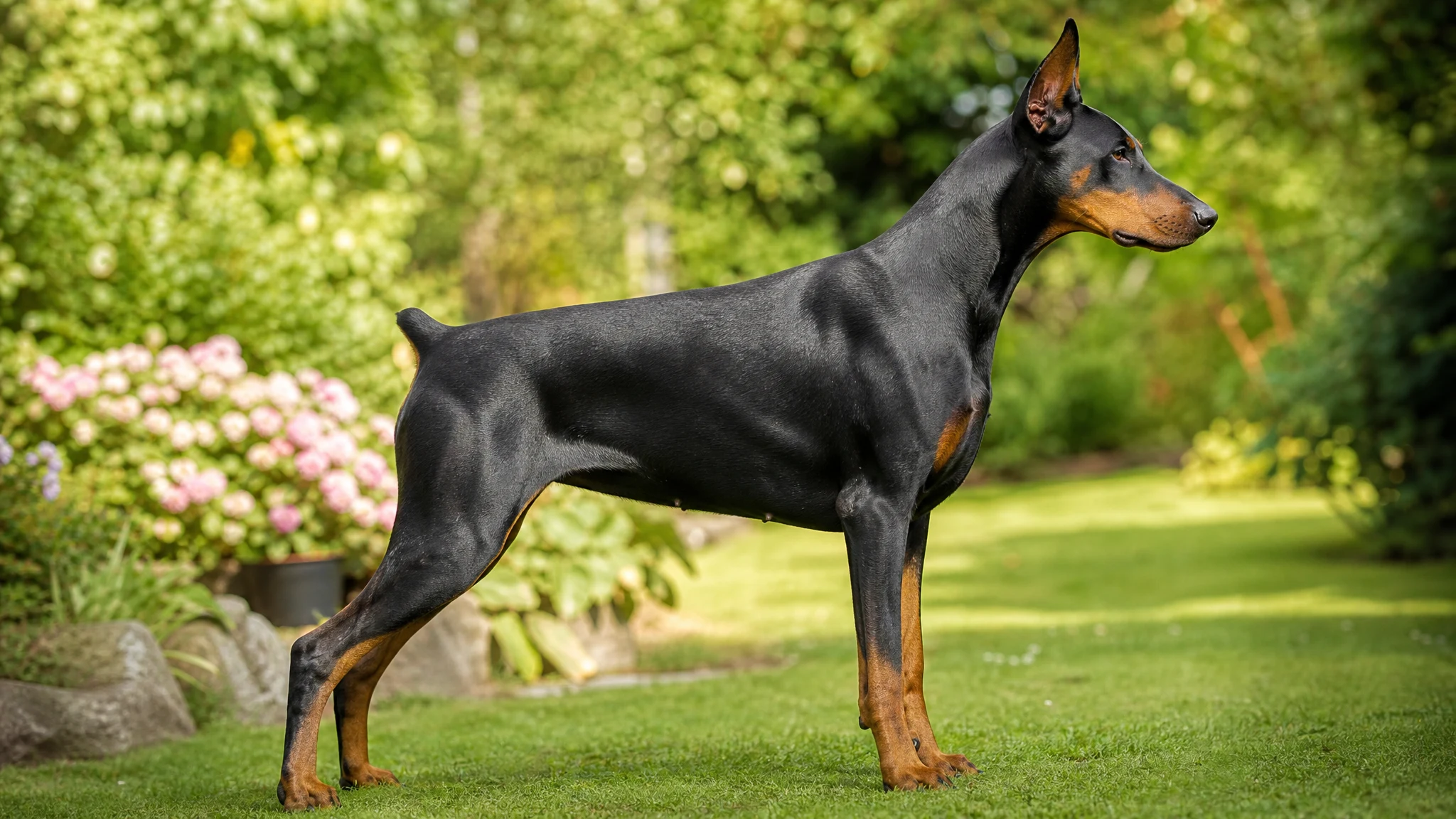
Hill's Pet Nutrition lists the Doberman as a large breed, with adults usually weighing 60 to 100 pounds and standing 24 to 28 inches tall. Males are usually heavier than females. PetMD gives the same 60 to 100 pound range.
Hill's also notes that Dobermans often keep filling out until age 2 or 3. That matters because puppies and adults need different foods, as Step 3 explains.
For more on the wider picture, see our guide to Doberman nutrition and the diet factors that matter.
Step 2: Track Symptoms for a Week or Two
Write down what your dog eats, including treats, chews and table scraps. Note stool quality, vomiting, gas and appetite each day.
This record helps your veterinarian spot patterns. It also keeps you from changing three things at once and not knowing which one mattered.
Step 3: Match the Food to the Life Stage
Find the AAFCO adequacy statement on the label. It tells you which life stage the food is built for.
For a Doberman puppy, the Whole Dog Journal explains that a food labeled for growth or all life stages must say either "including growth of large-size dogs (70 lb or more as an adult)" or "except for growth of large-size dogs." A Doberman puppy needs the "including" version.
Two Victor products show the "except" wording in practice. Victor Classic Hi-Pro Plus and Victor Chicken and Rice Formula Pate both exclude growth of large dogs, so they are not choices for Doberman puppies. Check the bag of any all life stages food for the "including" clause, because some brand pages did not show it clearly.
The Whole Dog Journal also notes that large puppy diets cap calcium at 1.8 percent on a dry matter basis. Large puppies need to grow slowly to protect their joints and bones. Do not add calcium to a complete and balanced diet.
Step 4: Compare Labels, Not Slogans
We compared label data from brand pages. We did not run feeding trials or taste tests, and we cannot say how any food will sit with your dog.
Here is what the label data shows for a few large-breed options.
| Food | Stage | First ingredients | Energy |
|---|---|---|---|
| Hill's Science Diet Adult Large Breed Chicken & Barley | Adult maintenance | Chicken, cracked pearled barley, brown rice, brewers rice, whole grain wheat | 365 kcal per cup |
| Hill's Science Diet Puppy Large Breed Chicken & Brown Rice | Growth, large breed puppies | Chicken, brown rice, whole grain oats, chicken meal, cracked pearled barley | 387 kcal per cup |
| Royal Canin Size Health Nutrition Large Breed Adult | Adult maintenance | Chicken by-product meal, brewers rice, wheat, brown rice, chicken fat | 360 kcal ME per cup |
| Freshpet Large Dog Multi-Protein Recipe | Adult maintenance | Chicken, egg, beef, salmon, beef liver | 348 kcal per cup |
A few cautions about this table. Hill's publishes average nutrient values, not guaranteed minimums, so we do not compare its protein and fat to the other brands. Kibble size was not stated on any page we opened. The Royal Canin figures came from retailer listings that disagreed slightly on fiber, so confirm the details on the bag.
Notice what the table cannot tell you: whether any of these will suit a sensitive digestive system. Ingredient order and calories describe the food, not your dog's response to it.
Step 5: Read the Grain-Free and DCM Question Carefully
Dilated cardiomyopathy (DCM) is a serious heart condition. Hill's says some Dobermans have a genetic predisposition for it and advises early screening and yearly monitoring.
The FDA began investigating a possible link between certain diets and canine DCM in July 2018. The agency looked at diets with peas, lentils, other pulses or potatoes high in the ingredient list, many labeled grain-free. Its last public update was December 23, 2022, and it has not established a cause.
Do not choose or avoid a food on that basis alone. Ask your veterinarian how diet fits with your Doberman's heart screening.
Step 6: Choose One Candidate and Check the Feeding Guide
Pick a single food that matches your dog's life stage and that your veterinarian is comfortable with. Then open the brand's own page for the full label.
- Hill's Science Diet Adult Large Breed
- Hill's Science Diet Puppy Large Breed
- Freshpet Large Dog Multi-Protein Recipe
- Victor Classic Hi-Pro Plus Large Breed Puppy
Treat feeding charts as starting points. For example, Hill's lists 3 1/4 cups a day for a 50 pound dog and 5 1/3 cups for a 100 pound dog on its adult large breed food, and says to adjust to maintain optimal weight. Your dog's activity and body condition matter more than the chart.
Split the daily amount into two meals. PetMD advises feeding adult Dobermans two meals a day instead of one larger meal to reduce bloat risk.
Step 7: Switch Foods Gradually
Do not swap foods overnight. Mix the new food in with the old in small amounts and shift the ratio over several days, following the brand's own directions.
Just Food For Dogs, for instance, recommends a slow introduction over 3 to 5 days for its fresh products. For other foods, check the brand page or ask your veterinarian how long to take.
Step 8: Watch, Record and Adjust
Keep logging meals and stools. Give the new food a fair trial before judging it, and keep treats and extras consistent while you do.
If symptoms continue or get worse, stop experimenting and call your veterinarian.
Common Mistakes to Avoid
- Changing foods too fast. A sudden switch can upset any dog's stomach.
- Changing several things at once. New food plus new treats makes the cause impossible to trace.
- Feeding an adult-only food to a puppy. Check for the large-size growth clause.
- Adding supplements on your own. A complete and balanced diet needs no added calcium, and other additions are a question for your vet.
- Trusting "sensitive" marketing. The word has no fixed label meaning in the data we reviewed.
- Feeding one big meal. Two smaller meals are the safer pattern for a deep-chested breed.
- Ignoring weight. The DPCA notes large breeds face higher risk of hip and elbow dysplasia, and weight control matters.
What Results to Expect
Some owners see firmer stools or steadier appetite after a careful, gradual change, but results vary and no outcome is certain. A new food may help, may make no difference, or may point to a cause your veterinarian needs to investigate.
Life expectancy for the breed is cited as 10 to 12 years by Hill's, though WSAVA cites Finnish statistics of about 8 years, mainly because of DCM. Regular checkups matter as much as the food you choose.
Sources
- Doberman Pinscher Club of America, Official Standard
- Doberman Pinscher Club of America, Health
- Hill's Pet Nutrition, Doberman Pinscher Dog Breed Guide
- PetMD, Doberman Pinscher Dog Breed Health and Care
- WSAVA, Meet the Dobermann
- FDA CVM, Investigation into Potential Link between Certain Diets and Canine DCM
- Whole Dog Journal, In the Fine Print: Nutritional Adequacy Statements
- Whole Dog Journal, Best Large Breed Puppy Food