Freeze-Dried Dog Food for Dobermans: How It Compares on the Label
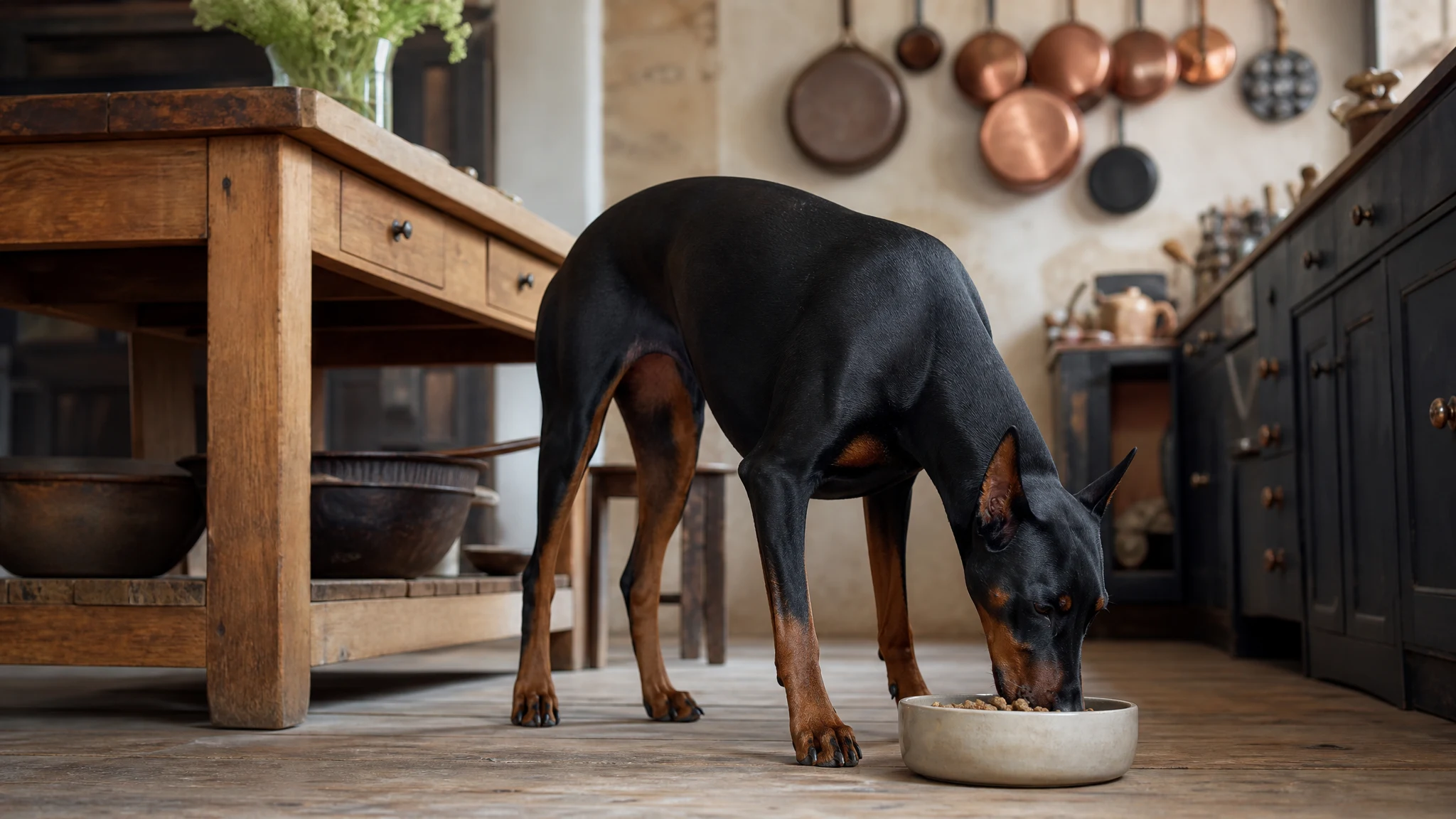
General nutrition information compiled from product labels and published sources, not veterinary advice. Your veterinarian is the right person to choose a diet for your dog, especially one with a health condition.
Freeze-dried food is often sold as a premium upgrade. Premium is a marketing word, not a label term. For a Doberman Pinscher, a large dog that Hill's Pet Nutrition puts at 60 to 100 pounds and 24 to 28 inches tall, the useful question is what the label actually says.
This guide shows a repeatable way to read any freeze-dried bag against a Doberman's needs. It will not crown a winner. If you want to find the best freeze dried dog food for your own dog, start with the label, not the front of the bag.
One honest note first. The brand label data we compared does not include a freeze-dried product, so we do not name one here. We also did not run feeding trials or taste tests. This is a label-reading method, and the examples come from published label data for other food types.
What You Need Before You Start
- The package or the brand's own product page for each food you are considering.
- Your dog's age and current weight.
- A pen and paper, or a simple spreadsheet, to line the foods up side by side.
- A measuring cup, to turn calories per cup into a daily amount.
- The name of your veterinarian, who makes the call for your individual dog.
There is no Doberman-specific formula in the label data we reviewed. Royal Canin and Hill's both sell by size, not by breed. Be wary of any bag that implies otherwise.
Step 1: Find the AAFCO Adequacy Statement
Look for a sentence that says the food is complete and balanced, and for which life stage. It might read "formulated to meet the nutritional levels established by the AAFCO Dog Food Nutrient Profiles for adult maintenance." That is the wording Freshpet uses for its Large Dog Multi-Protein Recipe.
If a bag has no such statement, or calls itself a topper, mixer or treat, it is not a complete diet. Do not use it as the main meal.
Step 2: Match the Life Stage to Your Dog
This step matters most for puppies. According to Whole Dog Journal, a food labeled for growth or all life stages must say either "including growth of large-size dogs (70 lb or more as an adult)" or "except for growth of large-size dogs (70 lb or more as an adult)." A Doberman puppy is expected to reach 60 to 100 pounds, so look for the "including" version.
Real labels show why this matters. Victor Classic Hi-Pro Plus and Victor Chicken and Rice Formula Pate both exclude growth of large dogs, so they are not for Doberman puppies. The Victor Hi-Pro Plus Large Breed Puppy page and the Freshpet Vital Large Breed page both say all life stages, but we could not confirm the large-size growth clause from the page text. Check the package for that sentence.
Whole Dog Journal also notes that large and giant breed puppy diets cap calcium at 1.8 percent on a dry matter basis, with a calcium to phosphorus ratio of about 1.1:1 to 1.4:1. It adds that a complete and balanced diet should not need added calcium. Ask the brand for these numbers if the bag does not print them.
Step 3: Read Protein, Fat and Fiber the Right Way
The guaranteed analysis lists minimum protein and fat and maximum fiber, usually as fed. Freeze-dried food has very little water, so its as-fed numbers will look much higher than a canned or fresh food. Comparing them directly with a wet food is misleading.
Compare like with like. Ask the brand for a dry matter figure, or convert the numbers yourself. Also remember that Hill's pages list "average" nutrient values, not guaranteed minimums. Do not place those averages in the same column as minimums.
Step 4: Check the First Five Ingredients
Ingredients are listed by weight as formulated. The first five show the foundation of the recipe. Note whether each is a named meat, a meal, or a by-product, and whether grains or potatoes appear.
On grain-free foods, the FDA has been investigating since July 2018 a possible link between certain diets and canine dilated cardiomyopathy (DCM). The diets in question had peas, lentils, other pulses or potatoes high in the ingredient list, and many were labeled grain-free. According to the FDA Center for Veterinary Medicine, its latest update was December 23, 2022, and no cause has been established. The FDA said it would not release further public updates until there is meaningful new scientific information.
This matters for Dobermans. Hill's says some Dobermans have a genetic predisposition for DCM and advises early screening and yearly monitoring. Talk to your veterinarian about diet and heart screening. A food label cannot settle that question.
Step 5: Convert Calories Into a Daily Amount
Find the calories per cup or per kilogram. Then use the brand's feeding chart as a starting point, not a rule. Hill's feeding guide for its large breed adult food, for example, runs from 3 1/4 cups a day for a 50 pound dog to 5 1/3 cups for a 100 pound dog, and tells owners to adjust to keep an optimal weight.
Dense foods need smaller scoops. Freeze-dried products are often measured by weight or by piece, so use the unit on the package. Weigh your dog every few weeks and adjust with your veterinarian's guidance. The Doberman Pinscher Club of America notes that large breeds face increased risk of hip and elbow dysplasia, and that weight control matters.
Step 6: Set Up Meals to Suit the Breed
PetMD advises feeding adult Dobermans two meals a day instead of one larger meal to reduce the risk of bloat (gastric dilatation volvulus). Some fresh foods, such as Freshpet's, say they can be fed as one meal or split into two. Choose two. Follow the package directions for rehydrating or serving freeze-dried food, and ask the brand if anything is unclear.
Step 7: Line Up the Foods Side by Side
Here is what the method looks like with the label data we have. These are real products from other categories, shown only to illustrate the comparison. Blank cells mean the page did not publish a minimum.
| Food | AAFCO life stage | Protein min | Fat min | Calories | First ingredients |
|---|---|---|---|---|---|
| Hill's Science Diet Puppy Large Breed Chicken & Brown Rice (dry) | Growth, large breed puppies | Average 26.7% (dry matter) | Average 15.4% (dry matter) | 387 kcal per cup | Chicken, brown rice, whole grain oats |
| Hill's Science Diet Adult Large Breed Chicken & Barley (dry) | Adult maintenance | Average 23.8% (dry matter) | Average 15% (dry matter) | 365 kcal per cup | Chicken, cracked pearled barley, brown rice |
| Royal Canin Size Health Nutrition Large Breed Adult (dry) | Adult maintenance | 24% | 15% | 360 kcal per cup | Chicken by-product meal, brewers rice, wheat |
| Victor Classic Hi-Pro Plus Large Breed Puppy (dry) | All life stages; check bag for the large-size growth clause | 30% | 14% | 365 kcal per cup | Chicken, chicken meal, brown rice |
| Freshpet Large Dog Multi-Protein Recipe (fresh) | Adult maintenance | 20% | 14% | 348 kcal per cup | Chicken, egg, beef |
Notice how the protein figures cannot be ranked fairly. A fresh food and a dry food carry different water amounts, and Hill's publishes averages. For the Royal Canin food, we relied on a retailer listing, and two retailers disagreed slightly on fiber, so confirm that figure with the brand. For the wider picture, see our label-by-label comparison of dog foods for Dobermans.
Tips for Reading Freeze-Dried Labels
- Ask the brand for the full AAFCO sentence if the website shows only a shortened version.
- Ask for calories per cup and per ounce or gram, and for the dry matter protein and fat.
- Switch foods slowly. Just Food For Dogs, for example, recommends introducing its food over 3 to 5 days.
- Keep a note of the date you changed foods and how your dog's stool, appetite and body condition look.
Common Mistakes to Avoid
- Trusting a puppy photo. Only the adequacy statement tells you whether growth of large dogs is covered.
- Comparing as-fed numbers across food types. Water content distorts them.
- Treating "grain-free" as a safety feature. The FDA has not established a cause for DCM, and the breed has its own genetic risk.
- Adding supplements to a complete diet without asking your veterinarian first.
- Feeding by the bag's chart alone. Charts are starting points. Body condition is the real guide.
What to Expect
A careful label comparison may help you narrow a crowded shelf to a few foods that fit your dog's life stage and size. It cannot show how your dog will do on any of them. Over several weeks, look for steady body condition, regular stools and normal energy. If something looks off, call your veterinarian.
No food can be said to prevent, treat or cure hip dysplasia, bloat, allergies or DCM. Prescription diets are something only a veterinarian prescribes. Life expectancy for the breed is given as 10 to 12 years by Hill's and PetMD, while the World Small Animal Veterinary Association cites Finnish statistics of about 8 years, mainly because of DCM. Regular screening matters more than any bag.
Sources
- Doberman Pinscher Club of America, Official Standard
- Doberman Pinscher Club of America, Health
- Hill's Pet Nutrition, Doberman Pinscher Dog Breed Guide
- PetMD, Doberman Pinscher Dog Breed Health and Care
- WSAVA, Meet the Dobermann
- FDA CVM, Investigation into Potential Link between Certain Diets and Canine Dilated Cardiomyopathy
- Whole Dog Journal, In the Fine Print: Nutritional Adequacy Statements
- Whole Dog Journal, Best Large Breed Puppy Food
- Hill's Science Diet Puppy Large Breed product page
- Victor Hi-Pro Plus Large Breed Puppy product page
- Freshpet Large Dog Multi-Protein Recipe product page