Wet vs Dry vs Fresh Food for Dobermans
General nutrition information compiled from product labels and published sources, not veterinary advice. Your veterinarian is the right person to choose a diet for your dog, especially one with a health condition.
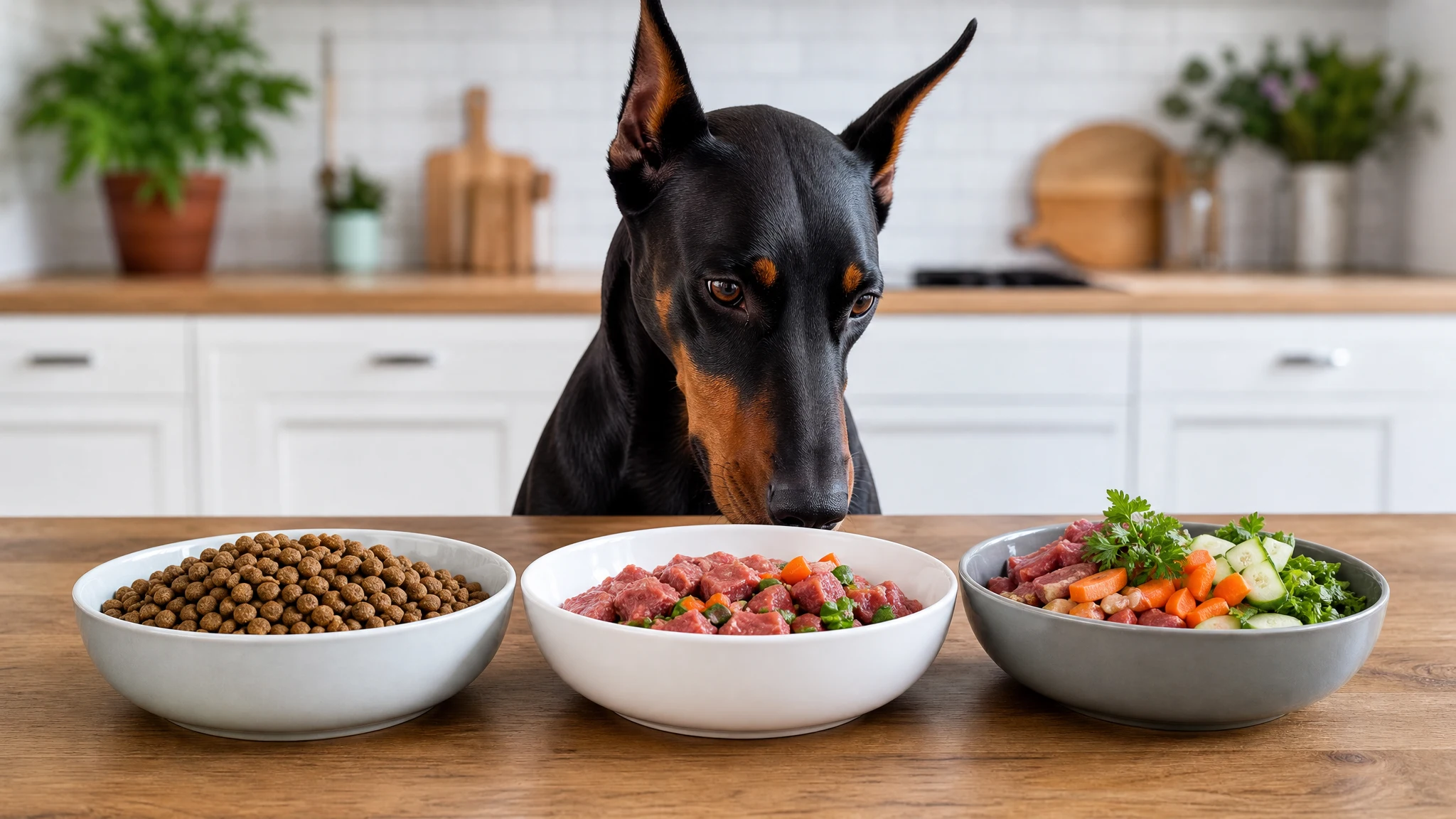
Every form of dog food can be complete and balanced. The label tells you that, not the picture on the front. So the wet vs dry dog food question for a Doberman is less about which form is "best" and more about which one fits your dog's life stage, your budget, your kitchen and your daily routine.
This guide compares the three forms using label data from products we could verify. We compared labels. We did not run feeding trials or taste tests, and nothing here is a result from feeding a dog.
What makes Dobermans a particular case
Hill's Pet Nutrition lists the Doberman as a large breed, and Hill's and PetMD both put adults at roughly 60 to 100 pounds. Males are usually heavier than females. That size matters for food form in three ways.
- Volume. A large dog eats a lot of food each day, so the form you pick changes how many cans, cups or packs you handle.
- Meal pattern. PetMD advises feeding adult Dobermans two meals a day instead of one large meal to reduce the risk of bloat (gastric dilatation volvulus). That applies to every form below.
- Puppy growth. Large puppies need to grow slowly. Whole Dog Journal describes large and giant breed puppy diets as capped at 1.8 percent calcium on a dry matter basis. Hill's notes that Dobermans often keep filling out until age 2 or 3.
No Doberman-specific formula turned up in the brand pages we checked. Foods are sized by weight class, such as "large breed", not by breed. If a bag claims a Doberman formula, read the label closely.
The three forms at a glance
The table uses real products with label data we could read. The products are examples of each form, not a ranking. Unit sizes differ (cups versus cans), so compare calories with care.
| Attribute | Dry (kibble) | Wet (canned pate) | Fresh (refrigerated or frozen) |
|---|---|---|---|
| Example labels | Hill's Science Diet Adult Large Breed; Victor Classic Hi-Pro Plus Large Breed Puppy | Victor Chicken and Rice Formula Pate | Freshpet Large Dog Multi-Protein Recipe; Just Food For Dogs Beef & Russet Potato |
| Moisture | Lowest of the three | High; the as-fed protein minimum is 9 percent and fiber maximum 1 percent | High; Freshpet lists 20 percent protein minimum and 1 percent fiber maximum as fed, Just Food For Dogs lists 8.5 percent protein minimum |
| Calories on the label | 352 to 406 kcal per cup across the dry foods we compared | 448 kcal per 13.2 oz can | 337 to 348 kcal per cup for Freshpet; 44 kcal per ounce for Just Food For Dogs |
| Cost per day (general terms) | Usually the lowest of the three for a large dog | Usually higher, because a large dog needs many cans | Usually the highest, and it needs fridge or freezer space |
| Storage | Sealed bag, room temperature | Cans, then refrigerate leftovers | Refrigerated or frozen; Freshpet says use within 7 days of opening |
| Puppy suitability | Some formulas, if the label says so | The Victor pate excludes growth of large dogs | Just Food For Dogs says not for growing puppies; check the Freshpet package |
| Kibble size | Not stated on the brand pages we compared | Not applicable | Not applicable |
Moisture: what the numbers really say
Moisture is the quiet reason these labels look so different. The Victor pate guarantees a 9 percent protein minimum as fed. The Victor Hi-Pro Plus Large Breed Puppy kibble guarantees 30 percent. That gap does not mean the pate is a weak food. Much of a can is water, so the same nutrients are spread across more weight.
Use caution when comparing protein and fat across forms. Only a dry matter conversion puts them on equal footing. Also, the three Hill's Science Diet pages publish "average" nutrient values rather than guaranteed minimums, so those figures should not be read as label guarantees.
Calories per serving
Calories are where wet food surprises people. One 13.2 oz can of the Victor pate carries 448 kcal. The Victor label suggests 3/4 to 1 can per 15 pounds of body weight for adults. Worked out for a Doberman, that is about 3 to 4 cans a day at 60 pounds and about 5 to 6.7 cans a day at 100 pounds. The label also says the amount depends on activity, age, environment and breed. Treat that as a starting point, then adjust with your veterinarian.
Dry food is far more compact. The Hill's Science Diet Adult Large Breed Chicken & Barley recipe lists 365 kcal per cup, with a guide of 3 1/4 cups a day for a 50 pound dog and 5 1/3 cups for a 100 pound dog. Fresh foods land near the dry range per cup, at 337 to 348 kcal for the two Freshpet recipes. Freshpet's page shows 2 1/2 to 3 cups a day for 51 to 65 pound dogs, so check the package chart for a heavier dog.
Whatever the form, the number on the bag is a guide. Watch your dog's body condition and adjust.
Dry food: pros and cons
Pros
- Compact calories. Feeding a large dog takes less storage and fewer containers.
- Most large-breed labels are easy to find, including puppy and mature adult versions. Hill's lists a large breed puppy food up to 18 months and an Adult 6+ Large Breed food for older dogs.
- Usually the lowest cost per day in general terms.
- Easy to portion into two meals a day.
Cons
- Lower moisture, so it is less appealing to some dogs.
- Kibble size was not stated on any brand page we compared. If your dog gulps food, ask the brand about the size before buying a large bag.
- Calorie-dense, so a scoop that is a little too generous adds up quickly.
Wet food for Dobermans: pros and cons
Pros
- High moisture and a soft texture that can suit dogs who are picky or recovering.
- A can is a simple, measured unit.
- Works as a small topper that adds interest to a bowl of dry food.
Cons
- Feeding wet food alone to a 60 to 100 pound dog means many cans a day, which raises cost and storage needs.
- The Victor Chicken and Rice Pate carries a statement that excludes growth of large dogs (70 pounds or more as an adult). It is an adult option for a Doberman, not a puppy food.
- Opened cans need refrigeration and have a short shelf life.
If you are weighing wet food for Dobermans, the strongest case is usually partial use as a topper or a veterinarian-guided choice for a dog with specific needs. Cost and can volume make it a harder fit as the only food.
Fresh dog food for Dobermans: pros and cons
Pros
- Ingredient lists are short and recognizable. Freshpet's large dog recipe lists chicken, egg, beef, salmon and beef liver first.
- Freshpet says its recipes can be fed as one meal or split into two. For a Doberman, PetMD's two-meal advice suggests splitting.
- Soft texture and high moisture.
Cons
- Needs refrigerator or freezer space, and large dogs go through it quickly.
- Usually the highest cost per day in general terms. Ask the brand for current pricing.
- Life stage varies. Just Food For Dogs says its Beef & Russet Potato recipe is not intended for growing puppies. The Freshpet Vital Large Breed page says all life stages, but we could not confirm whether it prints the large-size growth clause. Check the package.
- The FDA has investigated a possible link between certain diets and canine dilated cardiomyopathy (DCM). It looked at foods with peas, lentils, other pulses or potatoes high in the ingredient list, many labeled grain free. The FDA has not established a cause, and its most recent update was December 23, 2022. Some Dobermans carry a genetic predisposition for DCM, according to Hill's. The Just Food For Dogs recipe has potatoes and sweet potatoes in its first four ingredients and contains no grains, so it is worth discussing with your veterinarian. Grain-free status for that product comes from its ingredient list, not a statement on its page.
Dental myths
A common belief is that dry food cleans a dog's teeth and wet or fresh food ruins them. None of the product pages we compared makes a dental claim, and label data cannot settle it either way. Treat the idea that kibble does the work of brushing as unproven. Dental care for a Doberman is a conversation to have with your veterinarian, regardless of what is in the bowl.
Mixing forms
Many owners combine forms, for example kibble with a spoonful of pate or a fresh topper. It is a practical approach if you keep three things in mind.
- Count the calories of everything. Add the calories from each part and reduce the main meal so the total stays near the amount your dog needs.
- Check the life stage on each part. For a puppy, every food in the bowl should carry the "including growth of large-size dogs (70 lb or more as an adult)" wording, according to Whole Dog Journal's guide to adequacy statements. Foods that say "except for growth of large-size dogs", like the Victor pate and Victor Hi-Pro Plus adult formula, are not for Doberman puppies.
- Introduce changes slowly. Just Food For Dogs recommends a 3 to 5 day introduction, which is a reasonable pattern for any new food.
Keep two meals a day even when you mix, in line with PetMD's guidance for adult Dobermans.
Best for: recommendations by use case
- Doberman puppy: A large breed puppy dry food with the large-size growth clause printed on the bag. Examples with label data include the Hill's Science Diet Puppy Large Breed recipe (for growth, up to 18 months) and the Victor Hi-Pro Plus Large Breed Puppy, though you should check the bag for the clause on the Victor.
- Healthy adult on a budget: A dry large breed adult food, fed in two measured meals.
- Picky eater: A wet or fresh topper on the regular food, with the calories counted.
- Owner who values fresh ingredients and has fridge space: A fresh recipe labeled for adults, once you have confirmed the life stage and discussed DCM with your veterinarian.
- Older Doberman: A mature adult formula such as Hill's Adult 6+ Large Breed, or whatever your veterinarian suggests.
- Dog with a medical condition: The form your veterinarian recommends. Prescription diets are only something a veterinarian prescribes.
The verdict
No form wins outright. For most Dobermans, a complete and balanced dry food sized for large breeds, fed twice a day, is the easiest to verify, portion and afford. Its label states the life stage and calories plainly, and that makes it simple to compare against the other options.
Wet and fresh foods earn their place as toppers, as a response to a picky appetite, or as a main diet when your budget and storage allow it and your veterinarian is comfortable with the recipe. If you go that way, read the adequacy statement and the large-size growth wording, and count calories carefully. A large dog makes small mistakes show up fast.
None of these forms works as a remedy for, or a safeguard against, hip dysplasia, bloat, DCM or any other condition. Diet is one part of a Doberman's care, and your veterinarian decides what is right for an individual dog.
For a closer look at specific labels, see our label-by-label comparison of dog foods for Dobermans.
Sources
- Hill's Pet Nutrition, Doberman Pinscher Dog Breed Guide
- PetMD, Doberman Pinscher Dog Breed Health and Care
- Doberman Pinscher Club of America, Health
- WSAVA, Meet the Dobermann
- FDA CVM, Investigation into Potential Link between Certain Diets and Canine Dilated Cardiomyopathy
- Whole Dog Journal, In the Fine Print: Nutritional Adequacy Statements
- Whole Dog Journal, Best Large Breed Puppy Food
- Hill's Science Diet Adult Large Breed Chicken & Barley
- Victor Chicken and Rice Formula Pate
- Freshpet Large Dog Multi-Protein Recipe
- Just Food For Dogs Beef & Russet Potato