Best Training Treats for Dobermans and How Many to Give
General nutrition information compiled from product labels and published sources, not veterinary advice. Your veterinarian is the right person to choose a diet for your dog, especially one with a health condition.
Dobermans are quick, eager learners, and food is a handy way to reward them. The trouble is that a large, athletic dog can still gain weight on a steady stream of rewards. This guide shows you how to pick the best treats for dobermans, how to portion them, and how to fit them into a normal day of eating.
One honest note first. We did not taste-test or feed any treats for this page. The advice below rests on label-reading habits and on the breed information from the sources listed at the end. No treat or food is made specifically for Dobermans, so any claim to the contrary is marketing.
What You Need
- A few kinds of small, soft treats, or a portion of your dog's regular food set aside for training.
- A treat pouch or small container, so you can count out the day's rewards.
- A kitchen scale or a measuring cup, to measure the day's meals accurately.
- The calorie information from the treat package and from your dog's food bag.
- Your dog's current weight, age and a rough idea of daily activity.
What Makes a Good Training Treat for a Doberman
Training sessions can involve dozens of rewards. That is why size and calories matter more than flavor claims on the front of the bag.
- Tiny pieces. A treat only needs to be a taste. Pea-sized bites keep the session moving and keep calories low. Soft treats are easy to break apart. Crunchy ones take longer to chew and slow the work down.
- A clear calorie figure. Look for calories per treat or per serving. If the package does not list them, check with the brand before you rely on it. We have no calorie numbers for specific treats, so we will not guess at any.
- A short, readable ingredient list. Be skeptical of long lists of colors and flavor words. A treat does not need to sound like a meal.
- No claims about health. A treat that says it fixes joints, hearts or skin is making a promise that food labels cannot back up. Ignore those lines.
- Your dog's own food. Many trainers use part of the daily kibble as rewards. This is often the simplest way to keep the calorie count honest.
Step-by-Step: Setting Up Treats for Training
Step 1: Find your dog's daily food amount
Start with the main meals. The feeding guide on your dog's food bag is a starting point, not a rule. For example, Hill's Science Diet Adult Large Breed Chicken & Barley Recipe lists 365 kcal per cup and suggests 5 1/3 cups a day for a 100 lb dog, adjusted to keep an ideal weight. Your own dog may need more or less.
For amounts by age and weight, see our Doberman feeding chart by age and weight.
Step 2: Decide on a small treat budget
Treats count as food. Plan to keep them a small share of the day's calories, and ask your veterinarian what share suits your dog. We do not have a breed-specific percentage to give you, so do not rely on a number from a random source. Your dog's age, weight and health decide it.
Step 3: Take the treat calories out of the meals
If a training session will use a lot of treats, trim the meal a little to make up for them. Do this in small steps and watch your dog's body condition over a few weeks. The goal is a lean, athletic shape where you can feel the ribs under a light covering.
Step 4: Cut treats to the smallest useful size
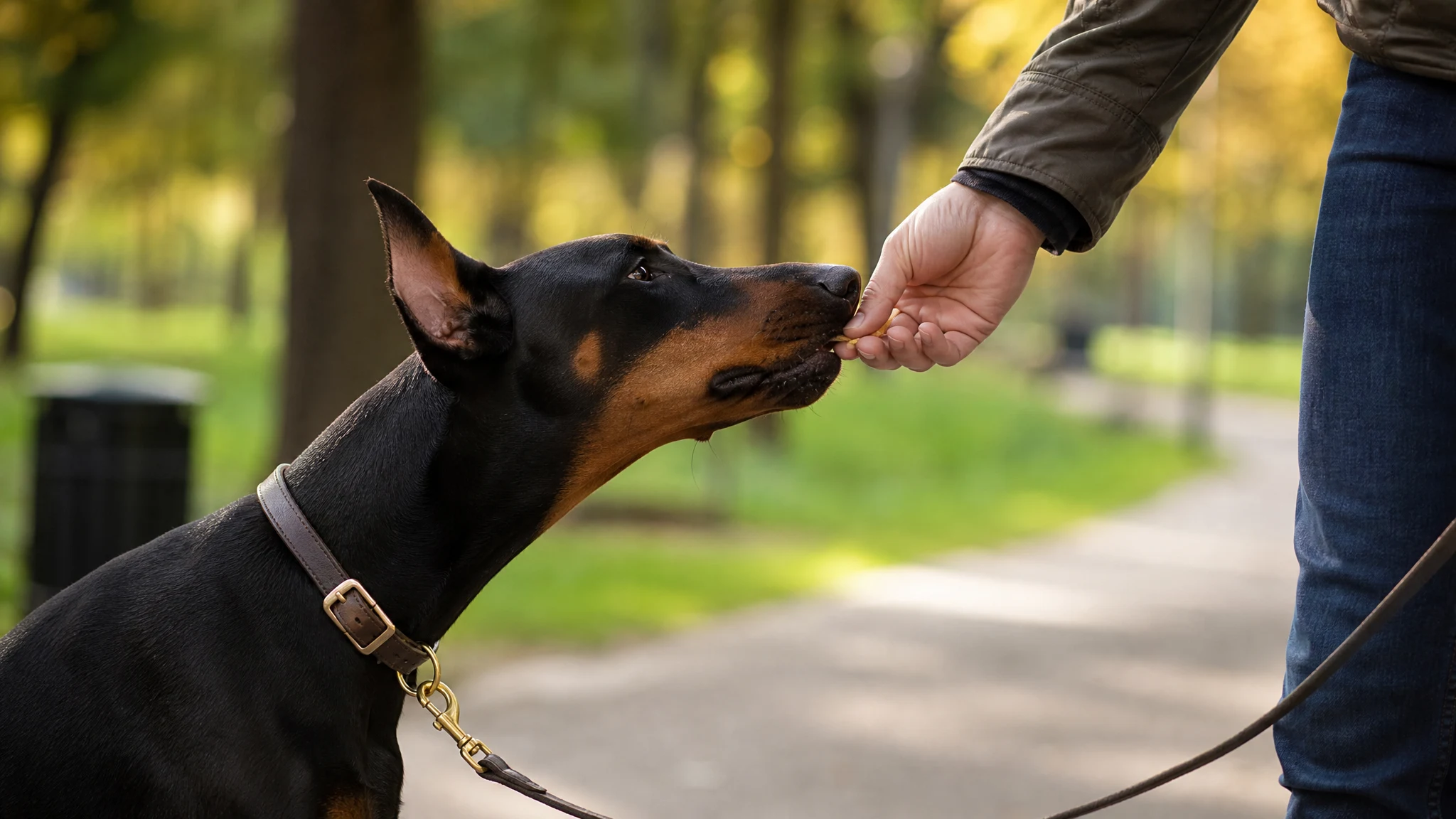
Break each treat into pieces about the size of a pea. A Doberman does not need a large reward for a good sit. The quick praise and the next cue matter more to many dogs than the size of the bite.
Step 5: Count the treats out before you start
Put the day's training treats in a pouch or small bowl each morning. When the pouch is empty, the rewards are done, or you switch to praise, a toy or a game. This stops the slow creep of extra treats from family members and visitors.
Step 6: Reward the behavior you want, right away
Mark the moment your dog does the right thing, then deliver the treat within a second or two. This is the reward-based approach supported by the American Veterinary Society of Animal Behavior (AVSAB). It builds a dog who wants to work with you. Do not use force, startling gear or intimidation to get results.
Step 7: Fade treats gradually
Once a behavior is solid, reward it every second or third time, then at random. Mix in praise, play and real-life rewards such as going through the door after a calm sit. This also trims the daily treat count without any extra effort.
Adjusting for Your Doberman's Age and Size
Adult Dobermans
Hill's Pet Nutrition describes the breed as large, at roughly 60 to 100 pounds, with males usually heavier than females. PetMD notes the same weight range. At that size, extra pounds add up quickly.
The Doberman Pinscher Club of America (DPCA) notes that large breeds face a higher risk of hip and elbow dysplasia, and it points to weight control as important. It also calls these conditions inherited. Treats cannot prevent or cure them, but keeping rewards small is one practical way to avoid excess weight.
Puppies
Puppies are in training from day one, so rewards add up. Whole Dog Journal explains that large-breed puppies should grow slowly, and that a complete and balanced growth diet should not need added calcium. It describes a maximum of 1.8 percent calcium on a dry matter basis for large and giant breed puppy foods. For that reason, skip calcium chews or mineral add-ons as rewards.
Check the puppy food label too. Under AAFCO rules, a food for growth must say either "including growth of large-size dogs (70 lb or more as an adult)" or "except for growth of large-size dogs." A Doberman puppy needs the "including" version. Some products, such as Victor Hi-Pro Plus and Victor Chicken and Rice Formula Pate, carry the "except" wording, so they are not suited to Doberman puppies. Hill's notes that Dobermans often keep filling out until age 2 or 3, so growth-stage feeding questions are best settled with your veterinarian.
Seniors
Hill's and PetMD give a life expectancy of 10 to 12 years, though WSAVA cites Finnish statistics closer to 8 years, mainly because of dilated cardiomyopathy (DCM). Older dogs often move less, so treat budgets may need to shrink. Your veterinarian can help you adjust.
Treats and Mealtime Rules for a Deep-Chested Breed
PetMD advises feeding adult Dobermans two meals a day instead of one large meal, to help reduce the risk of bloat (gastric dilatation volvulus, or GDV). Apply the same thinking to treats. Give small amounts spread across the day rather than a large pile at once. Avoid hard exercise right after a big reward session or a meal, and ask your veterinarian for timing advice for your dog.
Treats, Heart Health and Special Diets
Hill's says some Dobermans have a genetic predisposition for DCM and recommends early screening and yearly monitoring. The FDA began investigating a possible link between certain diets and canine DCM in July 2018, looking at diets with peas, lentils, other pulses or potatoes high in the ingredient list, many labeled grain-free. The FDA's last update was December 23, 2022, and no cause has been established.
That does not mean any treat is safe or unsafe for your dog. If your dog has a heart condition, food allergy, weight problem or any other health issue, confirm both the food and the treat amounts with your veterinarian before you change anything. Prescription diets are something only a veterinarian prescribes.
Common Mistakes to Avoid
- Not counting treats as food. They add calories even if they are tiny.
- Using large treats. Big pieces slow training and fill the daily budget fast.
- Giving treats for free. Handouts with no behavior attached teach your dog nothing and add calories.
- Trusting front-of-bag claims. Words such as "joint support" or "heart healthy" are not proof of anything for your dog.
- Adding calcium or supplement chews to a puppy's diet. A complete and balanced growth food should not need them. Ask your veterinarian before adding any supplement.
- Feeding the same treat for every task. Save the highest-value reward for harder work, and use plain kibble for easy cues.
- Using harsh training tools. Shock, prong and choke collars and dominance methods go against humane, reward-based practice.
Tips for Better Sessions
- Keep sessions short, a few minutes at a time, and end while your dog is still keen.
- Keep a few treat types on hand so you can vary the reward.
- Weigh your dog regularly, and compare your dog's shape to a body condition chart from your veterinarian.
- Tell everyone in the household what the daily treat budget is.
- If your dog gets loose stools or seems off after a new treat, stop it and call your veterinarian.
What to Expect
With small, well-timed rewards and a steady routine, many Dobermans learn basic cues quickly and stay engaged during training. A measured treat plan may also help you keep your dog at a lean, healthy weight, though results vary by dog. A dog's weight depends on many things, including food, exercise, age and genetics, so no treat plan can promise a specific outcome. If your dog's weight or energy changes, talk to your veterinarian.
Sources
- Doberman Pinscher Club of America, Official Standard
- Doberman Pinscher Club of America, Health
- Hill's Pet Nutrition, Doberman Pinscher Dog Breed Guide
- PetMD, Doberman Pinscher Dog Breed Health and Care
- WSAVA, Meet the Dobermann: Update Your Knowledge
- FDA CVM, Investigation into Potential Link between Certain Diets and Canine Dilated Cardiomyopathy
- Whole Dog Journal, Best Large Breed Puppy Food
- Whole Dog Journal, In the Fine Print: Nutritional Adequacy Statements
- Hill's Science Diet Adult Large Breed Chicken & Barley Recipe